ABC is committed to advancing science-based solutions that strengthen honey bee health, protect market integrity, and enhance the long-term sustainability of Alberta’s beekeeping industry. We strategically invest in research and innovation that delivers measurable value to beekeepers and positions Alberta as a global leader in high-quality honey production.
Through targeted research investment and strong partnerships, ABC is ensuring Alberta’s honey bees, and the industry they sustain, remain healthy, resilient, and globally competitive.
Download our Project Proposal Submission Form here. Please send all completed applications and supporting documentation to: Attention ABC Research Committee via Connie Phillips connie.phillips@albertabeekeepers.ca.
| Project title | Objectives | Researchers | Total Project Value | ABC Contribution | Status of completion | Reports |
|---|---|---|---|---|---|---|
| Miticide Resistance Program | Alberta’s Tech Transfer Program (TTP) and the Government of Alberta’s Bee Health Assurance Team (BHAT) have been proactively working to assess Apivar® efficacy across Alberta. Our goal is to continue randomly screen Varroa mite populations from across the province before treatments are applied in the fall. | Samantha Muirhead, Dr. Renata Labuschagne, Alexandra Panasiuk | Complete | Final report | ||
| Mass Storage of Summer-mated Queens During the Winter in Alberta | 1) Provide proof of concept that overwintering queens en masse is feasible in Alberta. 2) Develop prototype management strategies for mass overwintering queens in Alberta. 3) Validate the performance and quality of overwintered new summer-mated queens. | Dr. Shelley Hoover, Dr. Renata Labuschagne | $127,238 | Complete | Final report | |
| Comprehensive Comparison of Therapeutic Efficacy of Fumagillin-B, Prebiotics & Probiotics against Nosema Infection of Honey Bee Colonies | To compare therapeutic efficacy of Fumagillin B with efficacy of prebiotics and probiotics for prevention of Nosema infection in honey bees. | Dr. Elemir Simko | $57,500 | $57,500 | Sept 2021 | |
| A Study of Foulbrood in Canadian Apiaries | Foulbrood diagnosis and sequencing. | Dr. Carlos Castillo | $330,000 | $15,000 | March 2021 | |
| Apiculture Research in Alberta - Bee Researcher Position | To develop and deliver research programs that meet the needs of the beekeeping, leaf cutter bee and pollination industries in Alberta for both honey production and pollination. | Dr. Shelley Hoover | $1.2M | $275,000 | Complete | |
| Honey Bee Health Surveillance | $1.8M | $74,000 | Complete | |||
| Increased Sustainability Managing Bee Pest (Varroa Mites and Nosema) for Alberta Beekeepers | Developing alternative new miticides to enhance the rotation system for sustainable control of resistant Varroa and Nosema. | Dr. Shelley Hoover, Dr. Medhat Nasr, Dr. Rassol Bahreini, Dr. Rob Currie, Sam Muirhead, Dr. Tom Thompson | $553,858 | $115,000 | Complete | Final Report 1 Final Report 2 |
| Honey Bee Stock Performance Trial | To assess the performance of commercially available honey bee stocks in Alberta, using both domestic and imported stocks, and to correlate queen traits with colony-level performance. | Dr. Shelley Hoover | $105,000 | $35,000 | Complete | Final report |
| Getting More Bang for Your Buzz: Does pollination compensate for canola yield lost under sub-optimal soil moisture, nitrogen fertilization and/or seeding rates? | Does pollination compensate for canola yield lost under sub-optimal soil moisture, nitrogen fertilization and/or seeding rates? | Dr. Ralph Carter, Dr, Shelley Hoover, Dr. Steve Pernal | $275,000 | $80,000 | Complete | Abstract |
| Economic Benefits of Honey Bees in Alberta | Evaluation of the gross economic benefits of managed honey bees in Alberta in terms of both market and non-market values. | Nichols Applied Management Inc. | $23,000 | $0 | Complete | Final report |
| A Pilot study to compare the efficacy of oxalic acid sublimation devices to control Varroa mite in Alberta | The objective of this pilot study was to compare different models of OA vaporizers on Varroa infested colonies in late fall (November–December 2018) in Alberta. | Dr. Rassol Bahreini, Cassandra Docherty, Samantha Muirhead, Olivia de Herdt, Dr. Shelley Hoover | $746,000 | $320,500 | Complete | Final report |
| Project title | Objectives | Funders/ Collaborators | Total Project Value | ABC Contribution | Status | Reports |
|---|---|---|---|---|---|---|
| Tech Transfer Program (TTP) | Improving bee health, managing diseases and pests, investigating bee nutrition, developing and answering research questions, and overall improving beekeeping management and reducing operating costs across the Alberta beekeeping industry | ABC, CAP | $667,375 | $166,845 | February 2023 | TTP website |
| Honey Spray Drying - phase 2 | Develop and test a method to create a honey powder that can be used in beverages and other products | ABC, AF | $5,200 | $5,200 | Complete | Poster |
| Improving Energy Efficiency in Alberta’s Commercial Beekeeping Industry | Assess energy efficiency and utilization, as well as determine what practical green and traditional energy options exist to improve energy efficiencies on commercial beekeeping operations | ABC, CAP | $139,900 | $17,500 | Complete | Final report 1 Final report 2 |
| Telling Our Story – The Basics | Enhancing literacy, education and awareness about beekeeping and honey in Alberta | ABC, CAP | $95,532 | $23,383 | Complete | Hive Next Door campaign |
| Building Food Safety Capacity and Knowledge | Developing food safety tools for Alberta beekeepers | ABC, CAP | $43,270 | $10,817 | Complete | |
| Re-Supply of Fumagilin-B to Alberta & Strategic Plan for Development of Fumagillin Alternatives | Coordinate the activities of various industry stakeholders for reestablishing the supply of Fumagilin-B into Alberta in time for fall winterization of beehives by Alberta beekeepers, and develop a Strategic Plan for adopting alternative treatments for nosema over the medium to long term. | ABC, GRIN | $20,000 | $10,000 | Complete | Final report |
| Options for New Production of Fumagillin for Apiary Use in Alberta | Review of the current supply disruption of Fumagillin-B, an antibiotic that is important for maintaining hive health | ABC, MTN Consulting | $12,000 | $12,000 | Complete | Final report |
| Honey Authenticity Testing by NMR: A Market Impact Assessment | Feasibility study to determine and validate the benefits (financial or otherwise) for developing a standardized program for use in Alberta (and Canada), based on NMR for establishing product quality, traceability, and integrity | ABC, GRIN, MTN | $15,000 | $5000 | Complete | Final report |
| Design of a Smart Overwintering Storage Building for Honeybees | Design an overwintering storage building concept for use in Alberta | ABC, UofA | $0 | $0 | Complete | Final report |
| Exploring Export Market Opportunities - United Arab Emirates | Gain insight and understanding into the current available market for honey and honey-related products within the United Arab Emirates | ABC, Grant MacEwan | $0 | $0 | Complete | Final report |
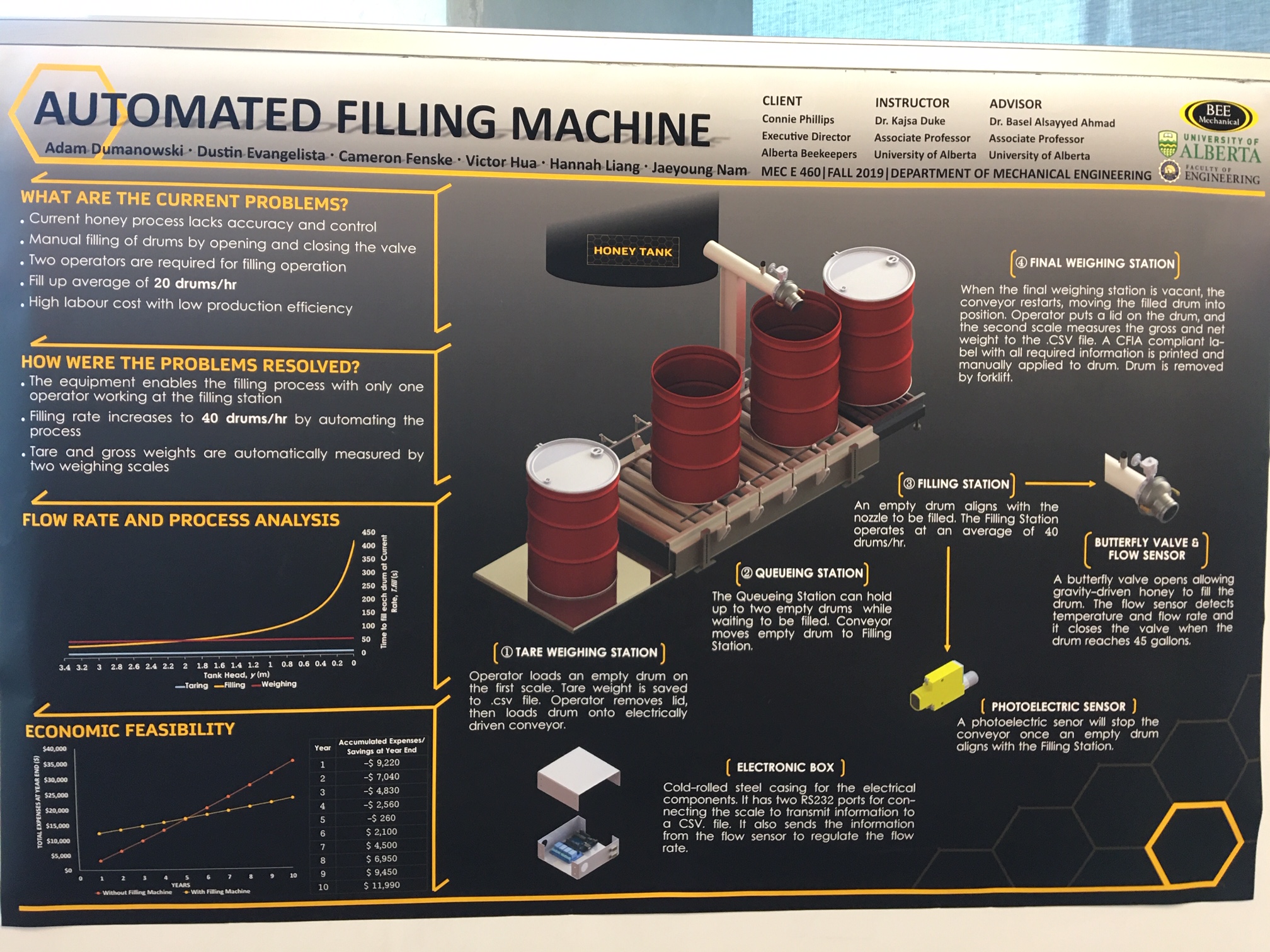
| Design of automated honey filling machine | Design a machine for automatic taring, queuing, filling and weighing honey drums | ABC, UofA | $0 | $0 | Complete | Poster |
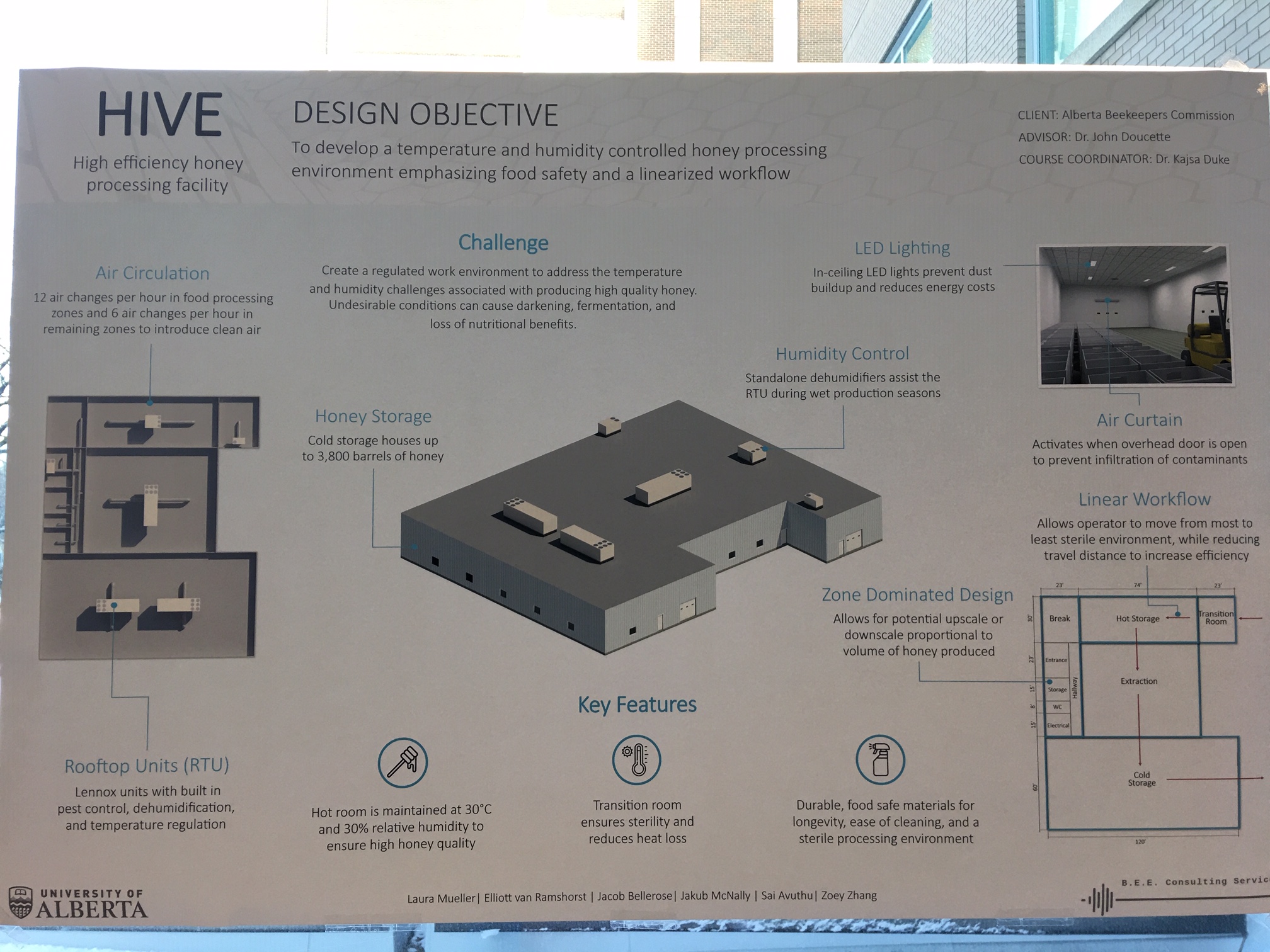
| High Efficiency Honey Processing Facility | To develop a temperature and humidity controlled honey processing environment emphasizing food safety and a linearized workflow | ABC, UofA | $0 | $0 | Complete | Poster |
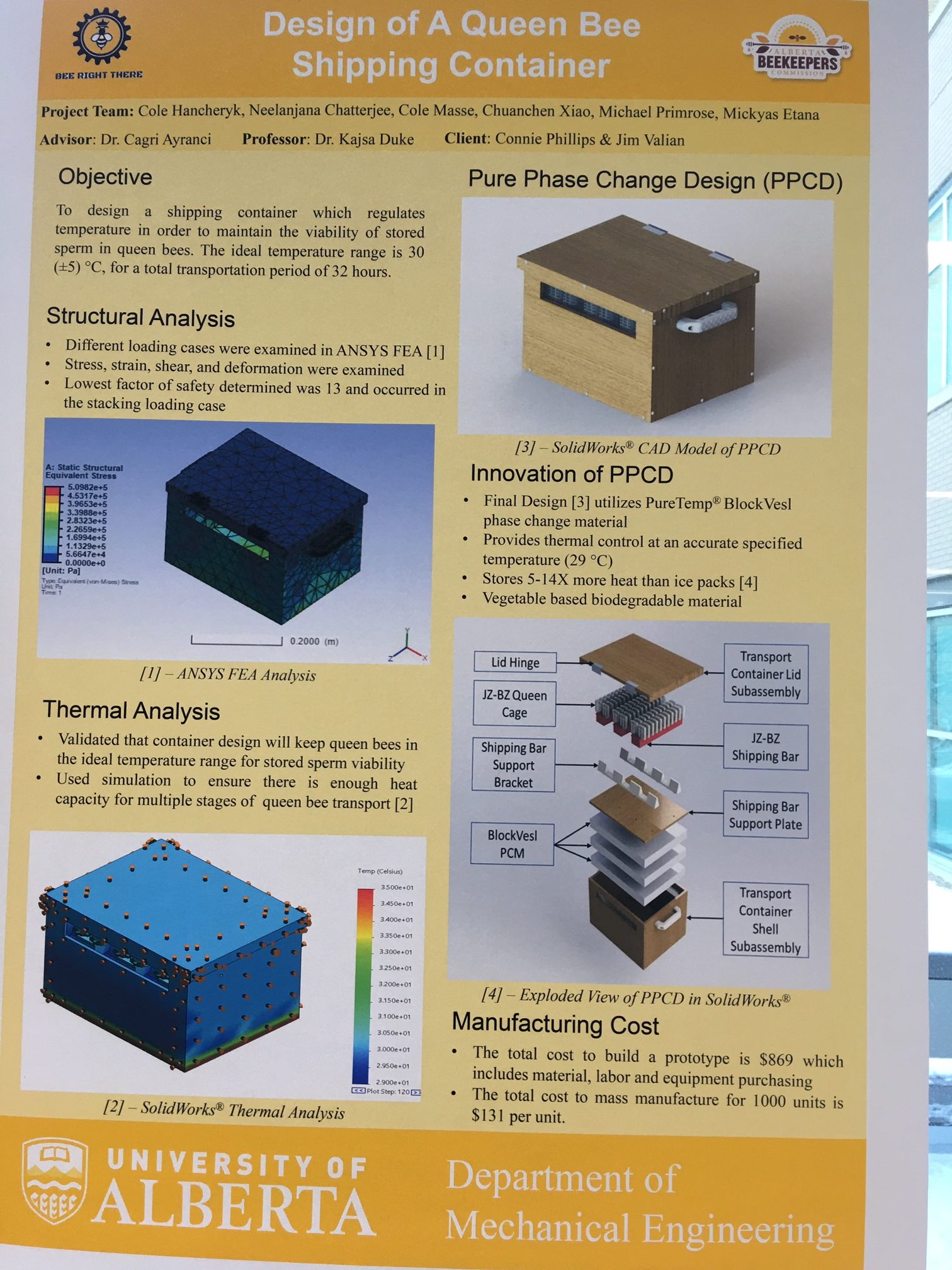
| Design of a Queen Bee Shipping Container | To design a shipping container which regulates temperature in order to maintain the viability of stored sperm in queen bees. The ideal temperature range is 30 (±5) °C, for a total transportation period of 32 hours | ABC, UofA | $0 | $0 | Complete | Poster |
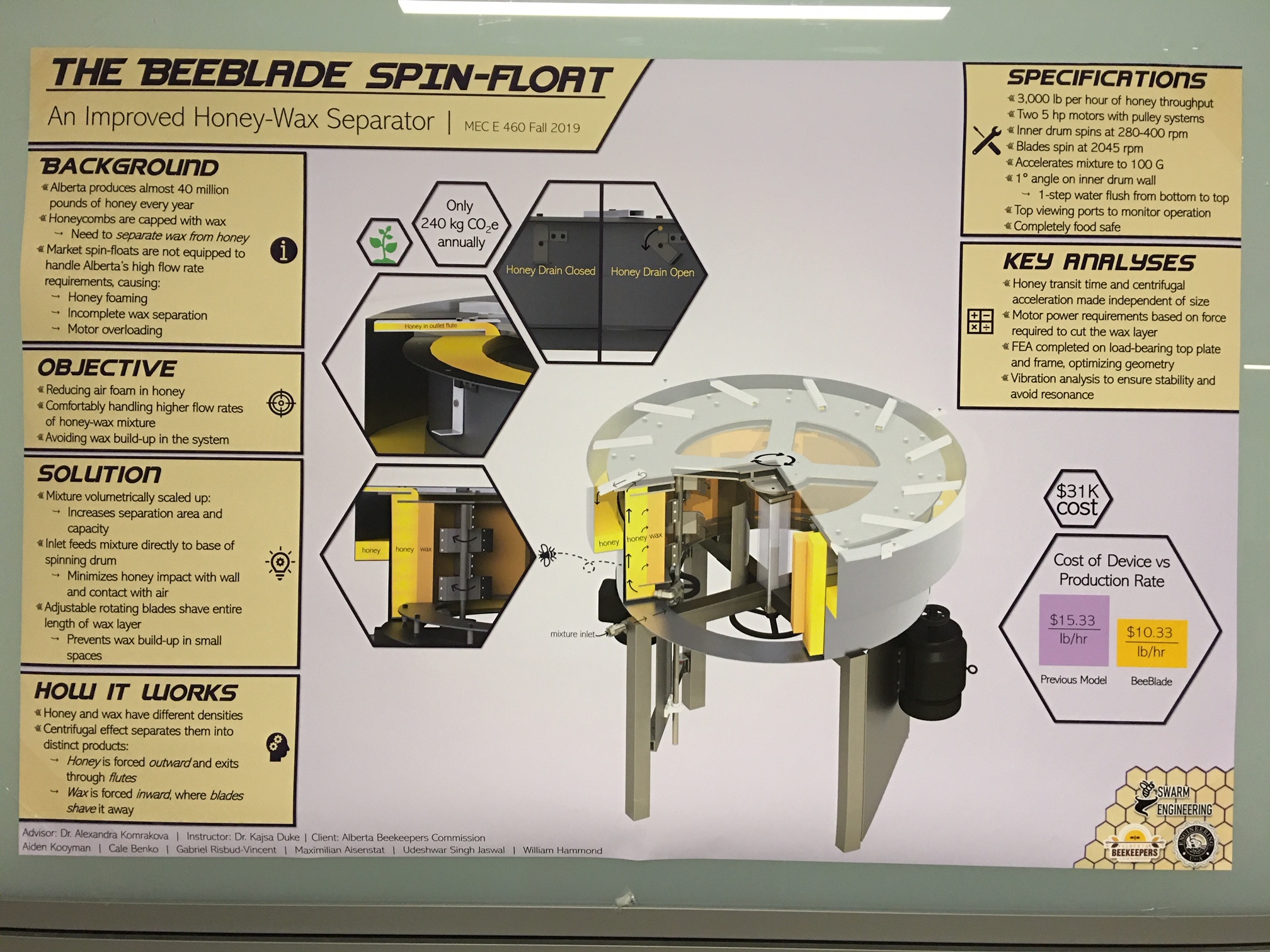
| Spin Float - Design of an Improved Honey/Wax Separator | Reducing air foam in honey, comfortably handling higher flow rates of honey/wax mixture, and avoiding wax build-up in the system | ABC, UofA | $0 | $0 | Complete | Poster |
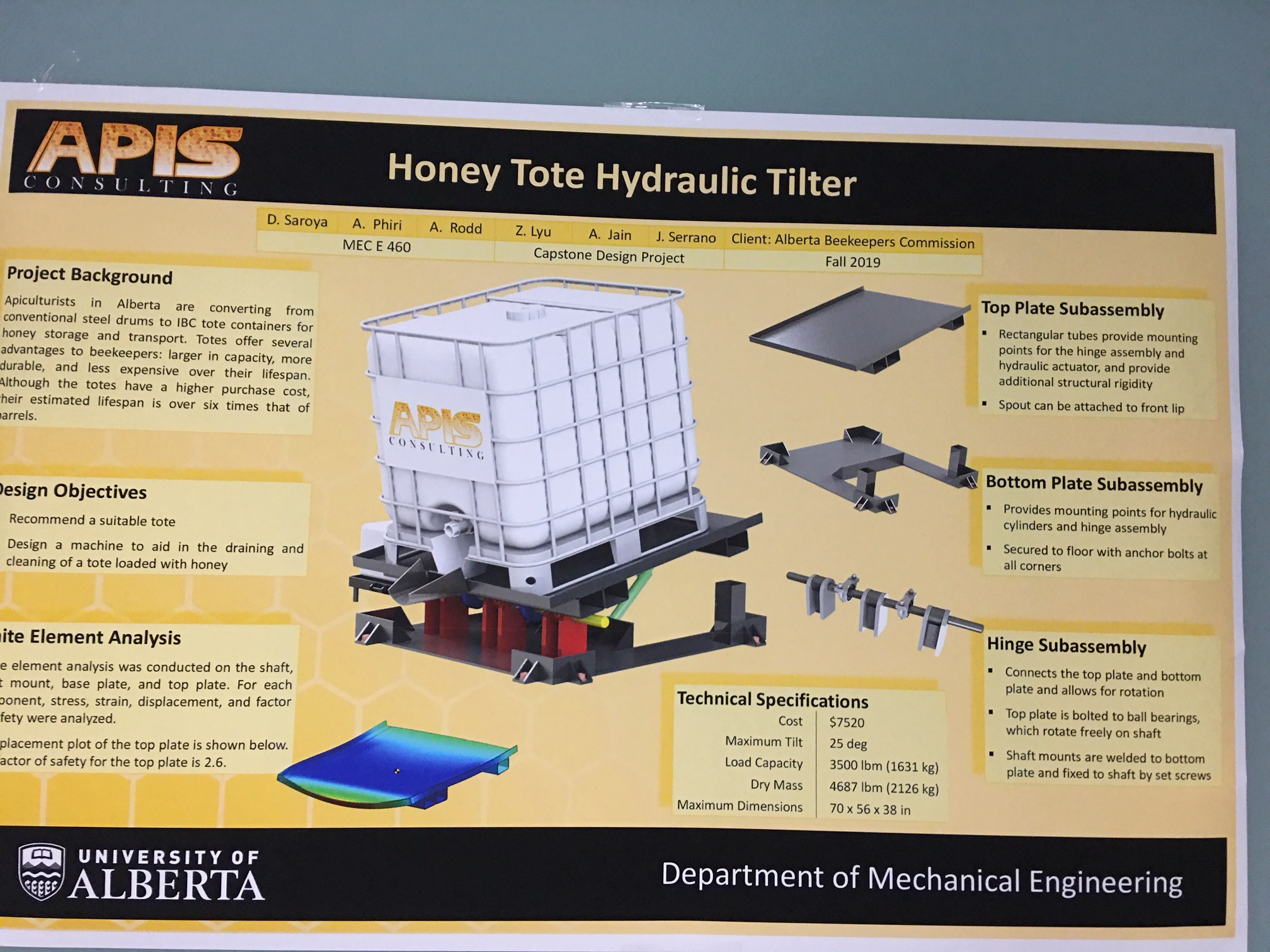
| Honey Tote Hydraulic Tilter | Recommend a suitable tote, and design a machine to aid in the draining and cleaning of a tote loaded with honey | ABC, UofA | $0 | $0 | Complete | Poster |
| Plastic Recycling | Find a solution for recycling of used plastic hive inserts | ABC, UofA | $0 | $0 | Complete | Poster |
| Top Feeder | Design a beehive top feeder | ABC, UofA | $0 | $0 | Complete | Final Report |
| Honey Cleaner | Find a way to clean honey containing debris and foam | ABC, UofA | $0 | $0 | Complete | Poster |
| Automated Frame Removal Device | The objective of SHYLM Design is to design an automated device to remove frames from the end of the honey extraction line and return the frames to the hive box. The design must be able to continuously pack the 8 frames in a hive box at the end of the extraction line. | ABC, UofA | $0 | $0 | Complete | Final Report Poster |